
Unexpected expenses don’t wait for your credit score to improve. Whether it is an urgent medical bill, a sudden car repair needed to get to work, or a home emergency, needing extra cash when your FICO score is in the “poor” range (below 580) can feel overwhelming.
When traditional banks turn you down, it is easy to assume you have zero options left. But here is the truth: you can still get a loan with bad credit in the United States.
Lenders today look beyond just three digits on a credit report. By understanding how bad credit lending works, exploring the right financial products, and taking specific steps to present yourself as a low-risk borrower, you can secure the money you need without falling into predatory debt traps.
In this guide, we will walk you through the entire process step by step—complete with practical examples, lender options, fee breakdowns, and red flags to avoid
What Is Considered “Bad Credit” in the USA?
In the United States, most financial institutions use the FICO Score model (ranging from 300 to 850) to evaluate your creditworthiness. Here is how FICO score ranges break down:
Here is how FICO score ranges break down:
| Credit Rating | FICO Score Range | Impact on Loan Approval |
| Exceptional | 800 – 850 | Easiest approval, lowest APRs |
| Very Good | 740 – 799 | Fast approval, very competitive interest rates |
| Good | 670 – 739 | Easy approval, standard market rates |
| Fair | 580 – 669 | Moderate approval odds, slightly higher rates |
| Poor / Bad | 300 – 579 | Harder to qualify, higher interest rates & fees |
If your credit score sits anywhere below 580, traditional lenders (like Chase, Bank of America, or Wells Fargo) will likely classify you as a high-risk borrower.
Why Does Your Credit Score Drop?
Your score drops primarily due to:
- Late or missed payments (35% of your FICO score)
- High credit utilization (30% of your score—using more than 30% of your limit)
- Defaulted loans, collections, or bankruptcy
- Lack of credit history (having a “thin” credit file)
Having bad credit does not mean you are bad with money. Life events like job loss, medical emergencies, or divorce often cause temporary financial setbacks. Fortunately, specialized lenders understand this reality.
How to Get a Loan with Bad Credit (6 Simple Steps)
If you need a personal loan right now, following a structured strategy increases your approval odds while keeping borrowing costs as low as possible.
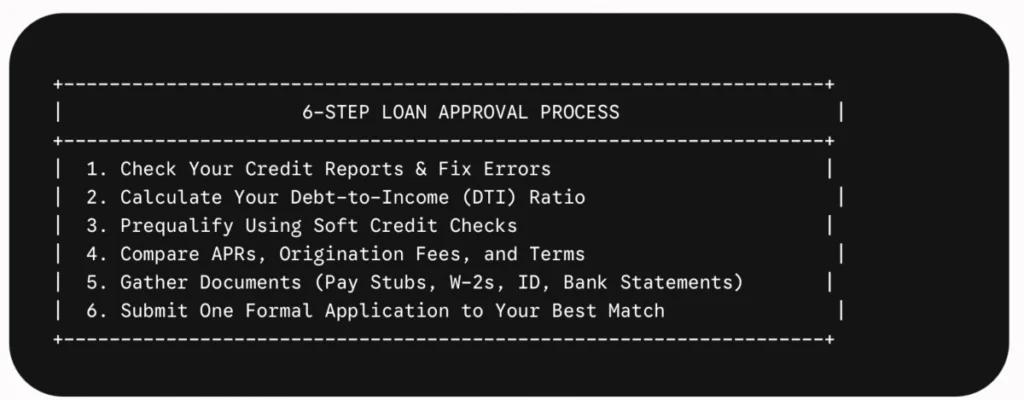
Step 1: Check Your Credit Score & Report for Errors
Before applying anywhere, check your official credit reports. Under US federal law, you can pull your credit reports for free from all three major credit bureaus (Equifax, Experian, and TransUnion) at AnnualCreditReport.com.
Pro Tip:
Up to 20% of credit reports contain errors—such as paid debts listed as unpaid or accounts opened under a similar name.
If you spot an error, dispute it immediately with the credit bureau. Removing an incorrect negative mark can boost your score by 20 to 50 points in just a few weeks.
Step 2: Calculate Your Debt-to-Income (DTI) Ratio
Lenders care about two main things: your credit history and your ability to repay. Your Debt-to-Income (DTI) ratio measures how much of your monthly gross income goes toward existing debt payments.
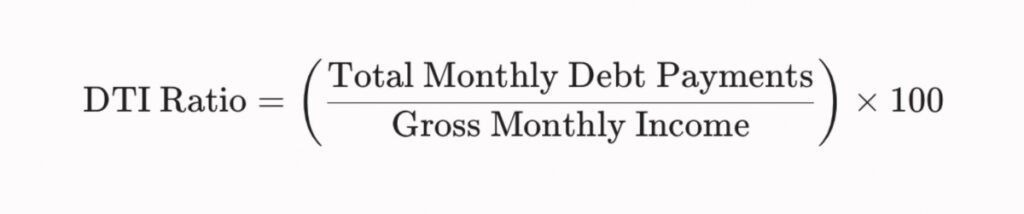
- Example – If you make $4,000 a month (before taxes) and your monthly debt payments (rent, credit card minimums, car loan) equal $1,400, your DTI is 35%.
- Target: – Lenders generally prefer a DTI ratio under 40% for bad-credit personal loans.
Step 3: Prequalify with Multiple Lenders
Never apply directly for multiple loans at once. Every formal loan application triggers a hard credit inquiry, which temporarily drops your score by 5 to 10 points.
Instead, use prequalification tool features offered by online lenders and comparison platforms.
Prequalification uses a soft credit check, which shows estimated interest rates, loan amounts, and terms without affecting your credit score
Step 4: Compare Total Loan Costs (APR vs. Interest Rate)
When comparing offers, always look at the Annual Percentage Rate (APR), not just the interest rate. The APR includes the interest rate plus upfront lender fees, giving you the true cost of borrowing.
Keep an eye out for Origination Fees (typically 1% to 12% for bad credit loans), which lenders deduct directly from your loan amount before sending funds to your bank.
Step 5: Gather Your Required Documentation
Having your paperwork ready speeds up the approval and funding process (often allowing same-day or next-day funding).
Most US lenders require:
- Government-Issued Photo ID: Driver’s license,
- US Passport, or State ID Proof of Income: Recent pay stubs, W-2 forms, 1099s, or 2 to 3 months of bank statements
- Proof of Residence: Utility bill, lease agreement, or mortgage statement
- Active Bank Account: For direct deposit of loan funds and setting up automatic payments
Step 6: Submit a Formal Application
Select the lender offering the lowest APR and terms that comfortably fit your monthly budget. Complete their online application and upload your documents. Once approved, review the loan agreement carefully before signing.
Best Loan Options for Bad Credit Borrowers in the US
Not all loans for bad credit are created equal. Here are the five safest and most accessible loan types available in the US market:
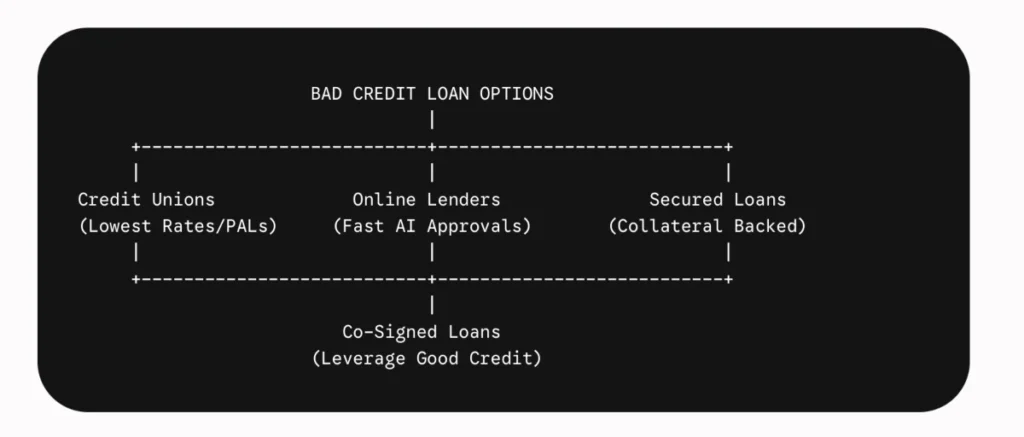
1. Federal Credit Unions & Payday Alternative Loans (PALs)
Credit unions are non-profit financial cooperatives owned by their members. Because they prioritize member service over profit, their interest rates are capped by law (typically 18% APR for standard loans).
- Payday Alternative Loans (PALs): Offered by many National Credit Union Administration (NCUA) federal credit unions.
- Loan Amount: $200 to $2,000
- Interest Rate Cap: Max 28% APR
- Repayment Terms: 1 to 12 months
- Requirements: You must be a credit union member (some allow immediate eligibility upon joining).
2. Online Lenders Utilizing Non-Traditional Data
Modern fintech lenders (such as Upstart, Avant, and Upgrade) look beyond standard credit scores. They use artificial intelligence to evaluate factors like your education history, job stability, income trend, and asset background.
- Pros: Fast online approval, funding in 1 to 2 business days, soft credit prequalification.
- Cons: Higher APRs for lower credit tiers (ranging from 18% to 35.99%).
3. Secured Personal Loans
If an unsecured loan application gets rejected, offering collateral can drastically improve your odds. A secured loan is backed by an asset you own, such as:
- A savings account or Certificate of Deposit (CD)
- Vehicle title (car, truck, or RV)
- Home equity (for larger loan amounts)
Warning: Because the loan is backed by collateral, the lender can seize your asset if you fail to make your monthly payments.
4. Co-Signed or Joint Loans
Applying with a co-signer or co-borrower who has good-to-excellent credit (700+ FICO) is one of the fastest ways to lower your interest rate.
- The co-signer legally agrees to take responsibility for repaying the loan if you default.
- Because the lender relies on the co-signer’s credit history, your approval chances increase significantly
5. Peer-to-Peer (P2P) Lending Networks
P2P platforms (like Prosper) connect individual investors directly with borrowers. Investors review loan listings and can choose to fund loans that traditional banks consider too risky.
Real-Life Example: How Sarah Got Approved for $4,000 with a 560 Credit Score
To see how this process works in real life, let’s examine a realistic scenario:
The Scenario
Sarah, a medical assistant living in Ohio, faced a $3,800 emergency transmission repair for her car. Without her vehicle, she couldn’t commute to work.
- Credit Score: 560 FICO (Poor) due to a medical collections account from two years ago.
- Gross Monthly Income: $3,600 ($43,200/year).
- Existing Debt Payments: $900/month (Rent & minimum credit card payments).
- DTI Ratio: $900 / $3,600 = 25% (Very healthy)
How Sarah Successfully Got Her Loan:
Step 1: Prequalification Shopping Sarah used a loan marketplace to prequalify with four different online lenders using soft credit checks. Three lenders offered options:
- Lender A: Rejected due to strict minimum score requirements (580).
- Lender B: Offered $4,000 at 32% APR with a 6% origination fee ($240).
- Lender C (Fintech/Income-Focused): Offered $4,000 at 24% APR with a 5% origination fee ($200).
Step 2: Checking Local Options Sarah also visited a local community credit union. She joined by making a $5 deposit. The credit union offered her a Payday Alternative Loan / Small Personal Loan of $4,000 at 18% APR with a $20 application fee, provided she set up direct deposit.
Step 3: Loan Execution & Final Numbers Sarah chose the credit union offer. Here is how her final 24-month loan structure looked:
Before accepting any loan offer, it is crucial to know exactly how much you will be paying each month to ensure it fits within your monthly budget. Using a Personal Loan EMI Calculator allows you to quickly adjust loan amounts, interest rates, and loan terms to see your exact estimated monthly installment before you formally apply
Loan Cost Comparison: Good Credit vs. Bad Credit vs. Predatory Loans
To understand the long-term financial impact of interest rates, let’s compare borrowing $5,000 over 3 years (36 months) across different credit profiles and loan types:
| Borrower Profile / Loan Type | Average APR Range | Estimated Monthly Payment | Total Interest Paid | Total Repayment Cost |
| Good Credit (700+ FICO) | 10% – 14% | $161 – $170 | $800 – $1,120 | $5,800 – $6,120 |
| Bad Credit Personal Loan | 24% – 32% | $196 – $218 | $2,050 – $2,848 | $7,050 – $7,848 |
| Credit Union (PAL / Small Loan) | 18% Max | $180 | $1,480 | $6,480 |
| Predatory Payday / Title Loan | 300% – 400%+ | ~$1,250/mo (Roll-over cycles) | $4,000 – $10,000+ | $9,000 – $15,000+ |
Notice how a predatory loan turns a $5,000 emergency into a long-term debt cycle. Always aim for installment personal loans with fixed APRs under 36%.
Red Flags & Dangerous Loan Scams to Avoid
When searching for loans with bad credit, you become a primary target for scams and predatory financial companies. Protect yourself by watching out for these red flags:
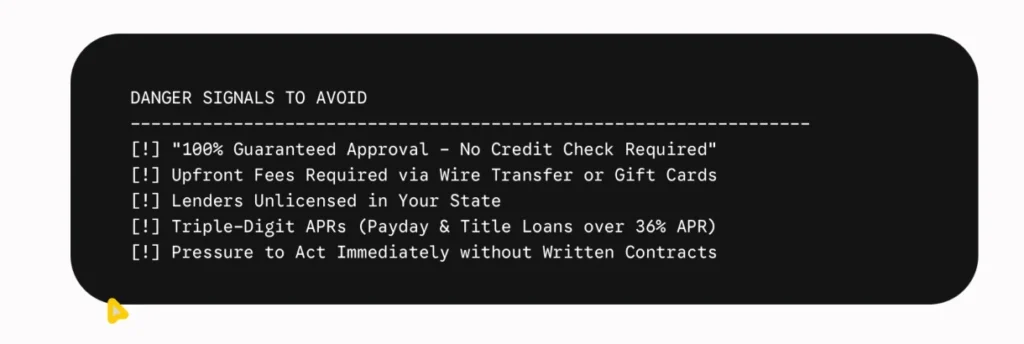
1. The Upfront Fee Scam
Legitimate lenders never ask you to pay money via wire transfer, Venmo, Zelle, or gift cards before issuing a loan. While legitimate lenders do charge origination fees, those fees are always deducted from the loan payout, not paid out of your pocket upfront.
2. “Guaranteed Approval” Promises
No legitimate lender can guarantee approval before reviewing your income, debt levels, and financial background. If an advertisement claims “100% Guaranteed Approval regardless of history,” it is usually a scam or a high-cost payday trap.
3. Payday and Auto Title Loans
Payday loans and auto title loans promise instant cash without a credit check, but they often carry astronomical APRs ranging from 300% to 500%.
- How the Trap Works: If you borrow $500 for two weeks, the fee might be $75. If you cannot pay the full $575 on your next payday, the lender “rolls over” the loan, adding more fees. Within months, borrowers often pay thousands of dollars in fees without reducing the original principal balance.
Smart Strategies to Build Your Credit While Repaying Your Loan
Getting a bad-credit personal loan isn’t just a way to solve an immediate financial crisis—it is also a powerful opportunity to repair your credit score for the future.
1. Set Up Autopay (Automatic Monthly Payments)
Payment history accounts for 35% of your FICO score. Setting up automatic payments ensures you never miss a due date. Bonus: Many US online lenders offer a 0.25% APR discount when you enroll in automatic payments.
2. Keep Your Credit Card Balances Low
If you use your loan proceeds to consolidate high-interest credit card debt, resist the urge to charge those credit cards again. Keeping your credit utilization ratio under 10% to 30% will accelerate your credit score recovery.
3. Confirm the Lender Reports to Credit Bureaus
Ensure your chosen lender reports your monthly payment activity to all three major US credit bureaus: Equifax, Experian, and TransUnion. Consistent, on-time payments over 12 to 24 months can boost your score back into the “Fair” or “Good” range (650+).
Final Thoughts: Taking Control of Your Financial Future
Having bad credit can make getting a loan more challenging, but it does not leave you without safe, affordable options. By avoiding high-cost payday loans, exploring federal credit unions, getting prequalified with multiple online lenders, and carefully calculating your monthly budget, you can get the cash you need today while setting yourself up for better credit tomorrow.
Next Step: Start by downloading your free credit reports at AnnualCreditReport.com to check for errors, calculate your monthly Debt-to-Income ratio, and prequalify with 2 to 3 reputable lenders to compare rates risk-free.
Getting out of debt and stabilizing your credit score is the first step toward long-term financial freedom. Once your loan is under control, consider putting any extra funds toward systematic investments. You can use a Daily SIP Calculator to see how micro-investing even small daily amounts can help you build a solid emergency fund and grow your wealth over time